
Thursday, July 06, 2006


This Day and days to come
I spent most of yesterday reading about Dorothy Day and the Catholic Worker, in an anthology of essays editted by William Thorn, Phillip Runkin, and Susan Mountin. A lot of her ideas and methods really appeal to me, speaking of concensus process. She and the co-founder of Catholic worker, Peter Maurin, developed these really exciting communities build on personalism, which was basically an adaptation of anarchism. No centralized structure, no party line, decisions by concensus and local autonomy... it's downright Baptist! (Recognizing that I use Baptist in the historical sense...) But she also had a really interesting relationship with the church, sometimes taking mass and protesting at the same cathedral. This book was particularly interesting for the range of uses the writers called Day out to support- some Catholic workers raged against others for not being authentically Catholic, and opposing the church, and other writers wrote as if it was against the spirit of the Catholic worker to not oppose the church. Both were true of Day's life. This kind of radical orthodoxy might be reflected in my own life, and my own attitudes to towards the church. A powerful love that recognizes the need for, and demands, appropriate reform and transformation... Perhaps this is something to aspire to. I look forward to learning more about the Catholic Worker movement.
I also learned that the house I'm applying to live in (in Chicago) is different from most houses, or at least most houses before Day's death in 1980, in that it is incorporated as a 501-C3 non-profit. Most Catholic Worker houses rejected this status as too close an alignment with an imperialist, militaristic, and capitalist government, and the accompanying evils. Many Catholic Workers also refused to take interest on any money in savings, seeing interest as usury and condemned by God. I don't know if I'm ready to ask my bank to stop compounding interest on my savings...
A few good lines that I copied down: the first is a quotation from Candinal Emmanuel Suhurd of Paris, that Day inscribed in her journal: "To be a witness does not consist in engaging in propaganda or even in stirring people up, but in being a living mystery; it means to live in such a way that one's life would not make sense if God did not exist."
The second is a line from Day's work, explaining what Peter Maurin was like. "Peter made you feel a sense of his mission as soon as you met him. He did not begin by tearing down, or by painting so intense a picture of misery and injustice that you burned to change the world. Instead, he aroused in you a sense of your own capacity for work, for accomplishment. He made you feel that you and all men had great and generous hearts with which to love God. If you once recognized this fact in yourself you would expect and find it in others."
My kind of method. I feel like I could basically live the rest of my life in Chicago, and among Catholic Workers, if I wanted to. Not that I want to right now, just that there's enough stuff to learn and do there, that I could without being bored.
I hope I get into the house in Chicago.
David
I also learned that the house I'm applying to live in (in Chicago) is different from most houses, or at least most houses before Day's death in 1980, in that it is incorporated as a 501-C3 non-profit. Most Catholic Worker houses rejected this status as too close an alignment with an imperialist, militaristic, and capitalist government, and the accompanying evils. Many Catholic Workers also refused to take interest on any money in savings, seeing interest as usury and condemned by God. I don't know if I'm ready to ask my bank to stop compounding interest on my savings...
A few good lines that I copied down: the first is a quotation from Candinal Emmanuel Suhurd of Paris, that Day inscribed in her journal: "To be a witness does not consist in engaging in propaganda or even in stirring people up, but in being a living mystery; it means to live in such a way that one's life would not make sense if God did not exist."
The second is a line from Day's work, explaining what Peter Maurin was like. "Peter made you feel a sense of his mission as soon as you met him. He did not begin by tearing down, or by painting so intense a picture of misery and injustice that you burned to change the world. Instead, he aroused in you a sense of your own capacity for work, for accomplishment. He made you feel that you and all men had great and generous hearts with which to love God. If you once recognized this fact in yourself you would expect and find it in others."
My kind of method. I feel like I could basically live the rest of my life in Chicago, and among Catholic Workers, if I wanted to. Not that I want to right now, just that there's enough stuff to learn and do there, that I could without being bored.
I hope I get into the house in Chicago.
David
two take-overs
I spent most of Monday reading about the conservative resurgence/ fundamentalist take-over in the Southern Baptist Convention, from 1979-1991 or so. The book I read is called "The New Crusades, the New Holy Land", by David Morgan, and it was very detailed if a little dry. It got me thinking about how this should apply to my own work with churches and other organizations. I think it's important to think about how one's organization might be "taken over" or "reappropriated" by those who disagree with the existing membership, or at least the existing leadership.
Basically, the SBC was taken over by a growing group of fundamentalists rallying around the issue of Biblical Inerrancy. (Wow! A Protestant denomination arguing over something other than sex!) Other issues played into it, but the litmus test for loyalty and support from this block of fundamentalists was whether you were willing to sign on to their idea of inerrancy. There were some possibly sketchy elections of national leaders at general conventions, but it was basically just a slow build of power, and forcing "liberals" (actually, non-fundamentalist conservatives, or even charismatics) off of agency boards and seminary faculties. Such an action is especially ironic in a Baptist body, which in theory has no centralized organization. However, what little was there was appropriated to the ends of those who would "regain control from liberals."
It brought to mind a story I heard about another take-over. Some years ago, there was a pretty active college republicans group at Oberlin. There's one now, but it just re-started this year, and had not been active since before I got here previously. Supposedly, the reason for this lull is that one year, the OC Republicans announced they were going to be holding elections at their next meeting. About five republicans showed up, and so did twenty-some members of Socialist Alternative. The SA members voted themselves into power, then promptly transferred the Republicans' budget to their own organization.
Now, I don't know how true that story is, but it has at least the possibility of truth. It's also kind of hilarious. Thinking about these two stories made me think about take-overs- is it important for organizations to think about how easily they could be taken over?
All of this points, I'm afraid, to the importance of knowing the bylaws of your organization. The fundamentalist SBC block had some folks that would pore over the bylaws for hours, strategizing. The Socialist Alternative folks took advantage of a weak spot in the structure and bylaws of the OC Republicans, and for all I know this weak spot has not yet been patched. In addition to making me worried for the ABC and the National Council of Churches, whose best moderate parliamentarian passed away this year, it makes me think about systems of government.
It makes me even gladder than I was that Peace Community Church, my church in Oberlin, is run by concensus. Concensus takes a long time to build, but this slowness can work against small groups that hope to over-run the established methods and practices of the existing body. I can see this back-firing, and working against justice, when a few hold-outs block the body from taking important action. But remembering these take-overs certainly makes me reflect on another piece of the usefulness of concensus.
It would also be interesting to think about the theological/ecclesiological implications of a chruch being "taken over", but that's for another day, and maybe for another person...
Basically, the SBC was taken over by a growing group of fundamentalists rallying around the issue of Biblical Inerrancy. (Wow! A Protestant denomination arguing over something other than sex!) Other issues played into it, but the litmus test for loyalty and support from this block of fundamentalists was whether you were willing to sign on to their idea of inerrancy. There were some possibly sketchy elections of national leaders at general conventions, but it was basically just a slow build of power, and forcing "liberals" (actually, non-fundamentalist conservatives, or even charismatics) off of agency boards and seminary faculties. Such an action is especially ironic in a Baptist body, which in theory has no centralized organization. However, what little was there was appropriated to the ends of those who would "regain control from liberals."
It brought to mind a story I heard about another take-over. Some years ago, there was a pretty active college republicans group at Oberlin. There's one now, but it just re-started this year, and had not been active since before I got here previously. Supposedly, the reason for this lull is that one year, the OC Republicans announced they were going to be holding elections at their next meeting. About five republicans showed up, and so did twenty-some members of Socialist Alternative. The SA members voted themselves into power, then promptly transferred the Republicans' budget to their own organization.
Now, I don't know how true that story is, but it has at least the possibility of truth. It's also kind of hilarious. Thinking about these two stories made me think about take-overs- is it important for organizations to think about how easily they could be taken over?
All of this points, I'm afraid, to the importance of knowing the bylaws of your organization. The fundamentalist SBC block had some folks that would pore over the bylaws for hours, strategizing. The Socialist Alternative folks took advantage of a weak spot in the structure and bylaws of the OC Republicans, and for all I know this weak spot has not yet been patched. In addition to making me worried for the ABC and the National Council of Churches, whose best moderate parliamentarian passed away this year, it makes me think about systems of government.
It makes me even gladder than I was that Peace Community Church, my church in Oberlin, is run by concensus. Concensus takes a long time to build, but this slowness can work against small groups that hope to over-run the established methods and practices of the existing body. I can see this back-firing, and working against justice, when a few hold-outs block the body from taking important action. But remembering these take-overs certainly makes me reflect on another piece of the usefulness of concensus.
It would also be interesting to think about the theological/ecclesiological implications of a chruch being "taken over", but that's for another day, and maybe for another person...
Monday, July 03, 2006
coming attractions for the nerdly
Here are some things that I am thinking about/ want to research sooner of later.
1. Non-geographic church affiliations. My Baptist church in Oberlin is a member of the Rochester region, mostly because we got kicked out of our local association for our views on including GLBT folks in the full life of the church. (Hint: we're for it.) I'm interested in looking at the history of other non-geographic regions and bodies, and seeing if any of that can inform Baptist life these days, which is seeing more and more of this non-geographic alignment stuff. I'd like to see how the old segregated Central Methodist Jurisdiction operated in a non-geographic space, and also how ethnic groups like the UCC's Calvin synod operate.
2. Both Anabaptist theologians and post-colonial theologians have written about the necessity of reading the gospel and the Bible in its context of empire, and the importance of framing Jesus as an enemy of empire. (And perhaps of seeing the contemporary church as called to oppose empire.) I would be interested to see how these multiple discussions of empire differ and over-lap. What do the mennonites and the po-co's have to say to each other? Are there any po-co anabaptists running around? I would be relatively surprised if no one's done this work already, but if they have, I haven't heard about it. Let's get some John Howard Yoder in dialogue with Kwok Pui-Lan or Sugirtharajah.
3. I've been taught to see most oppressive forces, and therefore movements as linked. For example, I can't talk about peace adn non-violence without talking about anti-racism and civil rights work, or at least I think I shouldn't. Lately I've heard a least a couple people around the age of 50 bemoan this kind of linking, or at least the way they play out. One of them complained about the number of different issues represented at a national anti-war demonstration. Another couldn't really see a connection between working for civil rights and working for non-violence. What is this about? And how do we as activists work on all these issues, that are linked, all at once, or properly work on one issue while acknowledging its connections to other oppressions? Anybody?
I'm in Oberlin this week, and resting at Beth's house. I'm spending today in Mudd to learn more about Dorothy Day, Catholic Worker, and the fundamentalist take-over of the Southern Baptist Convention. I'm excited about the prospect of living at a Catholic worker house next year, and I think that reading about the SBC can inform my own actions regarding denominational politics. I want to know enough about it to be able to talk about it with non-Baptists, and draw parallels with contemporary groups, movements, and ecclesiastical structures.
Any ideas or resources on these, let me know.
David
1. Non-geographic church affiliations. My Baptist church in Oberlin is a member of the Rochester region, mostly because we got kicked out of our local association for our views on including GLBT folks in the full life of the church. (Hint: we're for it.) I'm interested in looking at the history of other non-geographic regions and bodies, and seeing if any of that can inform Baptist life these days, which is seeing more and more of this non-geographic alignment stuff. I'd like to see how the old segregated Central Methodist Jurisdiction operated in a non-geographic space, and also how ethnic groups like the UCC's Calvin synod operate.
2. Both Anabaptist theologians and post-colonial theologians have written about the necessity of reading the gospel and the Bible in its context of empire, and the importance of framing Jesus as an enemy of empire. (And perhaps of seeing the contemporary church as called to oppose empire.) I would be interested to see how these multiple discussions of empire differ and over-lap. What do the mennonites and the po-co's have to say to each other? Are there any po-co anabaptists running around? I would be relatively surprised if no one's done this work already, but if they have, I haven't heard about it. Let's get some John Howard Yoder in dialogue with Kwok Pui-Lan or Sugirtharajah.
3. I've been taught to see most oppressive forces, and therefore movements as linked. For example, I can't talk about peace adn non-violence without talking about anti-racism and civil rights work, or at least I think I shouldn't. Lately I've heard a least a couple people around the age of 50 bemoan this kind of linking, or at least the way they play out. One of them complained about the number of different issues represented at a national anti-war demonstration. Another couldn't really see a connection between working for civil rights and working for non-violence. What is this about? And how do we as activists work on all these issues, that are linked, all at once, or properly work on one issue while acknowledging its connections to other oppressions? Anybody?
I'm in Oberlin this week, and resting at Beth's house. I'm spending today in Mudd to learn more about Dorothy Day, Catholic Worker, and the fundamentalist take-over of the Southern Baptist Convention. I'm excited about the prospect of living at a Catholic worker house next year, and I think that reading about the SBC can inform my own actions regarding denominational politics. I want to know enough about it to be able to talk about it with non-Baptists, and draw parallels with contemporary groups, movements, and ecclesiastical structures.
Any ideas or resources on these, let me know.
David
Sunday, July 02, 2006
Eva and the Cascade Mountains

Here is a picture of Eva. I brought her from Oberlin. I had to cut off 8 leaves to fit her on the train, and I took her out of her pot and triple-bagged her roots and the soil around them. Now she's repotted and her new leaf is unfurling!
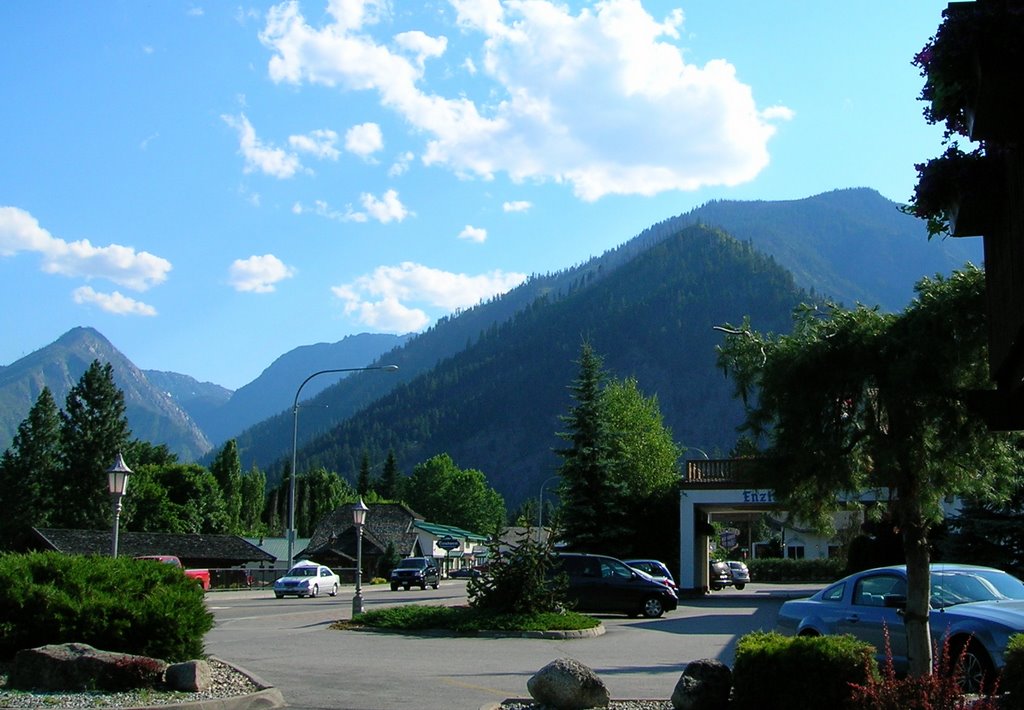
This picture was taken on the porch of my friend in Seattle. She picked me up from the train in WA and fed me and my aunt picked me up the next day. We drove into the Cascade Mountains for a family reunion. Here are the mountains!
i knitted a dolphin


I knitted a dolphin without using a pattern and gave it to a little girl who named it Fin Fin. It has googly eyes and I was able to make it because of the variety of fancy stiches Bethany Draeger taught me in order to make that stegosaurus! Yay!
(It's about 6 inches long and 2 inches fin to fin)
Saturday, July 01, 2006
Thoughts from the month of June
I suppose I haven't been contributing, because I haven't gone anywhere yet, and am just starting to figure out how the communication with friends thing might work after being so close (in a small town) to some of you for five years. So, here's what I've been thinking about!
First, reasons why camping (actually "cabin-ing") with the Peachey's and Parrishes is paradise:
1. Among the parents are a geophysicist who smashes rocks, makes maps and talks about time travel, a librarian whose dissertation is on Dorothy Day and the Catholic Worker movement and loves talking about historical utopian societies, two peace and justice advocates; one who does peace education in the Mennonite church, uses bad puns fairly regularly, the other who does womans advocacy in the Mennonite church, has a Master of Divinity degree, and loves to talk about books and President Bush.
2. Among the "children", almost all of whom are over 18 by now, are a music teacher who's getting much better at guitar playing, a tree-and-hiking-without-shoes loving international development major, a pianist and French speaking quilt-maker who's spending a year in France in the fall and a violinist who happens to play and love soccer.
3. All of the aforementioned people generally bring 2 or 3 or more books to the cabin, leaving them lying around everywhere, so that everyone can read any of them, whenever they want. Then, if you have a book you want to talk about you can "present" it to the group, and have a discussion.
4. Hammocks, campfires and s'mores are involved.
5. We saw chipmunks, toads, and baby deer on some amazing hikes. We (the four children) also got lost once, and stuck with our very dubious trail much longer than we should have because of the inadequate map we had. Our resident geologist later pointed out the flaws of this map in great detail.
Second, leaving Oberlin.....:
I'm not sure what I'm thinking about this right now...I'll be ready to go, but I'm not as excited about heading to Guatemala as I was a month or two ago. Maybe because I've had to be so focused here with spending time with friends before they leave. Also, it seems like my job won't really wind down much before I leave-we have this three week tutoring program that finishes my last week here, and so I'm still having to really focus on that, and I have a good amount of reporting left to do on what happened with the tutoring programs the past year.
So, in two weeks, all of the sudden, I'll be done (not because there isn't still work to do at the two organizations I've been working at), but because my committment will be fulfilled. I think it will feel pretty strange.
Once I get home, I want to find some cool stuff to do...ideas of interesting/helpful/cool stuff to do for three months, anyone??
First, reasons why camping (actually "cabin-ing") with the Peachey's and Parrishes is paradise:
1. Among the parents are a geophysicist who smashes rocks, makes maps and talks about time travel, a librarian whose dissertation is on Dorothy Day and the Catholic Worker movement and loves talking about historical utopian societies, two peace and justice advocates; one who does peace education in the Mennonite church, uses bad puns fairly regularly, the other who does womans advocacy in the Mennonite church, has a Master of Divinity degree, and loves to talk about books and President Bush.
2. Among the "children", almost all of whom are over 18 by now, are a music teacher who's getting much better at guitar playing, a tree-and-hiking-without-shoes loving international development major, a pianist and French speaking quilt-maker who's spending a year in France in the fall and a violinist who happens to play and love soccer.
3. All of the aforementioned people generally bring 2 or 3 or more books to the cabin, leaving them lying around everywhere, so that everyone can read any of them, whenever they want. Then, if you have a book you want to talk about you can "present" it to the group, and have a discussion.
4. Hammocks, campfires and s'mores are involved.
5. We saw chipmunks, toads, and baby deer on some amazing hikes. We (the four children) also got lost once, and stuck with our very dubious trail much longer than we should have because of the inadequate map we had. Our resident geologist later pointed out the flaws of this map in great detail.
Second, leaving Oberlin.....:
I'm not sure what I'm thinking about this right now...I'll be ready to go, but I'm not as excited about heading to Guatemala as I was a month or two ago. Maybe because I've had to be so focused here with spending time with friends before they leave. Also, it seems like my job won't really wind down much before I leave-we have this three week tutoring program that finishes my last week here, and so I'm still having to really focus on that, and I have a good amount of reporting left to do on what happened with the tutoring programs the past year.
So, in two weeks, all of the sudden, I'll be done (not because there isn't still work to do at the two organizations I've been working at), but because my committment will be fulfilled. I think it will feel pretty strange.
Once I get home, I want to find some cool stuff to do...ideas of interesting/helpful/cool stuff to do for three months, anyone??
Subscribe to:
Posts (Atom)